
Abstract
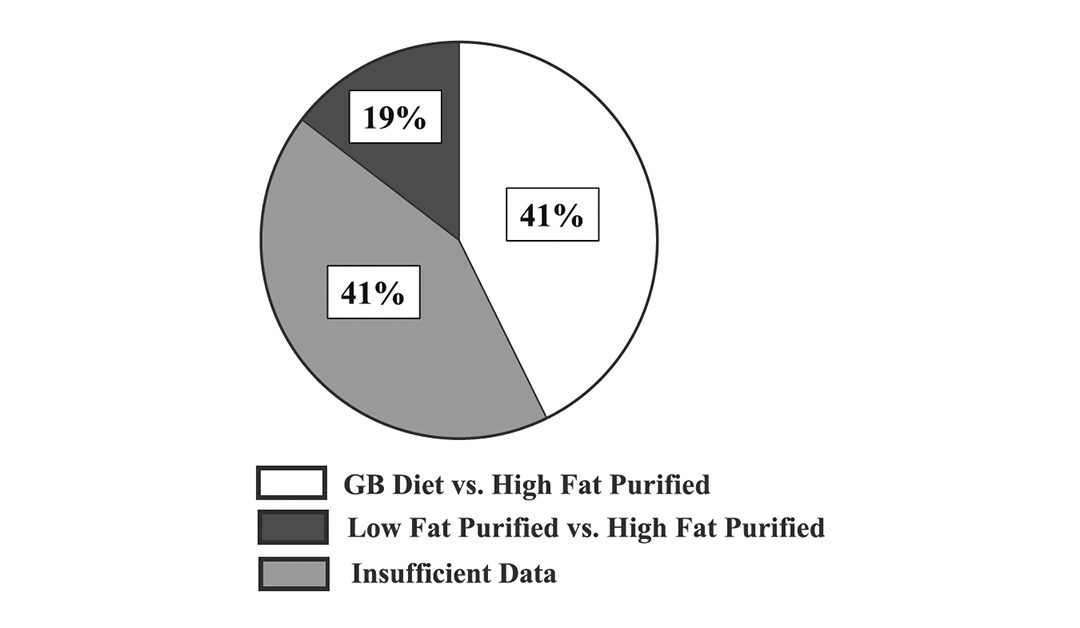
Diets used to induce metabolic disease are generally high in fat and refined carbohydrates and importantly, are usually made with refined, purified ingredients. However, researchers will often use a low fat grain-based (GB) diet containing unrefined ingredients as the control diet. Such a comparison between two completely different diet types makes it impossible to draw conclusions regarding the phenotypic differences driven by diet. While many compositional differences can account for this, one major difference that could have the greatest impact between GB and purified diets is the fiber content, both in terms of the level and composition. We will review recent data showing how fiber differences between GB diets and purified diets can significantly influence gut health and microbiota, which itself can affect metabolic disease development. Researchers need to consider the control diet carefully in order to make the best use of precious experimental resources.
References
- Fodde R, Schmitt M, Schewe M, Augenlicht LH. Modelling western dietary habits in the mouse. Hepato Biliary Surg Nutr. 2017;6(2):138–40.
- Institute for Laboratory Animal Research. In: National Research Council, editor. Guidance for the description of animal research in scientific publications. Washington, D.C.: The National Academies Press; 2011.
- Omary MB, Cohen DE, El-Omar EM, Jalan R, Low MJ, Nathanson MH, et al. Not all mice are the same: standardization of animal research data presentation. Gastroenterology. 2016;150(7):1503–4.
- Rendina-Ruedy E, Smith BJ. Methodological considerations when studying the skeletal response to glucose intolerance using the diet-induced obesity model. Bonekey Rep. 2016;5:845.
- Warden CH, Fisler JS. Comparisons of diets used in animal models of high-fat feeding. Cell Metab. 2008;7(4):277.
- Kilkenny C, Browne WJ, Cuthill IC, Emerson M, Altman DG. Improving bioscience research reporting: the ARRIVE guidelines for reporting animal research. PLoS Biol. 2010;8(6):6–10.
- General considerations for feeding and diet formulation. In: Subcommittee on laboratory animal nutrition, committee on animal nutrition, board on agriculture, National Research Council nutrient requirements of laboratory animals, fourth revised edition. Washington, D.C: National Academy Press; 1995. p. 3–10.
- Greenman D, Oller W, Littlefield N, Nelson C. Commercial laboratory animal diets: toxicant and nutrient variability. J Toxicol Environ Health. 1980;6:235–46.
- Newberne PM. Influence on pharmacological experiments of chemicals and other factors in diets of laboratory animals. Food Sources Incidental Drug Expo. 1975;34:209–18.
- Mead MN. The feed factor: estrogenic variability in lab animal diets. Environ Health Perspect. 2006;114(11):A640–2.
- Jensen MN, Ritskes-Hoitinga M. How isoflavone levels in common rodent diets can interfere with the value of animal models and with experimental results. Lab Anim. 2007;41(1):1–18.
- Kozul CD, Nomikos Athena P, Hampton TH, Warnke LA, Gosse JA, Davey JC, et al. Laboratory diet profoundly alters gene expression and confounds genomic analysis in mouse liver and lung. Chem Biol Interact. 2008;173(2):129–40.
- Rao GN, Knapka JJ. Contaminant and nutrient concentrations of natural ingredient rat and mouse diet used in chemical toxicology studies. Fundam Appl Toxicol. 1987;9(2):329–38.
- Silverman JA, Adams JD. N-nitrosamines in laboratory animal feed and bedding. Lab Anim Sci. 1983;33(2):161–4.
- Hrncir T, Stepankova R, Kozakova H, Hudcovic T, Tlaskalova-Hogenova H. Gut microbiota and lipopolysaccharide content of the diet influence development of regulatory T cells: studies in germ-free mice. BMC Immunol. 2008. https://doi.org/10.1186/1471-2172-9-65.
- Coleman WE, Tardiff RG. Contaminant levels in animal feeds used for toxicity studies. Arch Env Contam Toxicol. 1979;8(6):693–702.
- Schecter AJ, Olson J, Papke O. Exposure of laboratory animals to polychlorinated dibenzodioxins and polychlorinated dibenzofurans from commercial rodent chow. Chemosphere. 1996;32(3):501–8.
- Mesnage R, Defarge N, Rocque LM, De Vendômois JS, Séralini GE. Laboratory rodent diets contain toxic levels of environmental contaminants: implications for regulatory tests. PLoS One. 2015;10(7):e0128429. https://doi.org/10.1371/journal.pone.0128429.
- Ito S, Chen C, Satoh J, Yim S, Gonzalez FJ. Dietary phytochemicals regulate whole-body CYP1A1 expression through an arylhydrocarbon receptor nuclear translocator-dependent system in gut. J Clin Invest. 2007;117(7):1940–50.
- Zhang L, Nichols RG, Patterson AD. The aryl hydrocarbon receptor as a moderator of host-microbiota communication. Current Opinion in Toxicology. 2017;2:30–5.
- Wise A. Interaction of diet and toxicity—the future role of purified diet in toxicological research. Arch Toxicol. 1982;50:287–99.
- Almeida-Suhett CP, Scott JM, Graham A, Chen Y, Deuster PA. Almeida-Suhett nutritional neuroscience 2017 control diet in a high-fat diet study in mice: regular chow and purified low-fat diet have similar effects on phenotypic, metabolic, and behavioral outcomes. Nutr Neurosci. 2017:1–11.
- Turnbaugh PJ, Ley RE, Mahowald MA, Magrini V, Mardis ER, Gordon JI. An obesity-associated gut microbiome with increased capacity for energy harvest. Nature. 2006;444(7122):1027–31.
- Turnbaugh PJ, Ridaura VK, Faith JJ, Rey FE, Knight R, Gordon JI. The effect of diet on the human gut microbiome: a metagenomic analysis in humanized Gnotobiotic mice. Sci Transl Med. 2009;1(6):1–12.
- den Besten G, van Eunen K, Groen AK, Venema K, Reijngoud D-J, Bakker BM. The role of short-chain fatty acids in the interplay between diet, gut microbiota, and host energy metabolism. J Lipid Res. 2013;54(9):2325–40.
- Kuo S-M. Reviews from ASN EB 2012 symposia the interplay between fiber and the intestinal microbiome in the inflammatory response. Adv Nutr. 2013;4:16–28.
- Wise A, Gilburt DJ. The variability of dietary fiber in laboratory-animal diets and its relevance to the control of experimental conditions. Food Cosmet Toxicol. 1980;18:643–8.
- Cromwell GL, Cline TR, Crenshaw JD, Crenshaw TD, Easter RA, Ewan RC, et al. Variability among sources and laboratories in analyses of wheat middlings. J Anim Sci. 2000;78:2652–8.
- Rutten AAJL, de Groot AP. Comparison of cereal-based diet with purified diet by short-term feeding studies in rats, mice and hamsters, with emphasis on toxicity characteristics. Food Chem Toxicol. 1992;30(7):601–10.
- Chassaing B, Miles-Brown J, Pellizzon M, Ulman E, Ricci M, Zhang L, et al. Lack of soluble fiber drives diet-induced adiposity in mice. Am J Physiol Gastrointest Liver Physiol. 2015;309(7):G528–41.
- Dalby MJ, Ross AW, Walker AW, Correspondence PJM, Morgan PJ. Dietary uncoupling of gut microbiota and energy harvesting from obesity and glucose tolerance in mice. Cell Rep. 2017;21:1521–33.
- Desai MS, Seekatz AM, Koropatkin NM, Kamada N, Hickey CA, Wolter M, et al. A dietary fiber-deprived gut microbiota degrades the colonic mucus barrier and enhances pathogen susceptibility. Cell. 2016;167(5):1339–1353.e21.
- Miles JP, Zou J, Kumar M, Pellizzon M, Ulman E, Ricci M, et al. Supplementation of low- and high-fat diets with fermentable fiber exacerbates severity of DSS-induced acute colitis. Inflamm Bowel Dis. 2017;0(0):1–11.
- Torre-Villalvazo I, Tovar AR, Ramos-Barragán VE, Cerbón-Cervantes MA, Torres N. Soy protein ameliorates metabolic abnormalities in liver and adipose tissue of rats fed a high fat diet. J Nutr. 2008;138(3):462–8.
- Adam CL, Williams PA, Garden KE, Thomson LM, Ross AW. Dose-dependent effects of a soluble dietary fibre (pectin) on food intake, adiposity, gut hypertrophy and gut satiety hormone secretion in rats. PLoS One. 2015;10(1):1–14.
- Blay L, Michel C, Cherbut C. Prolonged intake of Fructo-oligosaccharides induces a short-term elevation of lactic acid-producing bacteria and a persistent increase in Cecal butyrate in rats. J Nutr. 1999;129:2231–5.
- Levrat M-A, Rémésy C, Demigné C. High propionic acid fermentations and mineral accumulation in the cecum of rats adapted to different levels of inulin. J Nutr. 1991;121(11):1730–7.
- Respondek F, Gerard P, Bossis M, Boschat L, Rabot S, Wagner A, et al. Short-chain Fructo-oligosaccharides modulate intestinal microbiota and metabolic parameters of humanized Gnotobiotic diet induced obesity mice. PLoS One. 2013;8(8):e71026.
- Adam CL, Williams PA, Dalby MJ, Garden K, Thomson LM, Richardson AJ, et al. Different types of soluble fermentable dietary fibre decrease food intake, body weight gain and adiposity in young adult male rats. Nutr Metab (Lond). 2014;11(1):36.
- Nakamura S, Kondo N, Yamaguchi Y, Hashiguchi M, Tanabe K, Ushiroda C, et al. Daily feeding of fructooligosaccharide or glucomannan delays onset of senescence in SAMP8 mice. Gastroenterol Res Pract. 2014;2014:303184.
- Neyrinck A, Hé EV, Piront N, De Backer F, Toussaint O, Cani P, et al. Wheat-derived arabinoxylan oligosaccharides with prebiotic effect increase satietogenic gut peptides and reduce metabolic endotoxemia in diet-induced obese mice. Nutr Diabetes. 2012;224. https://doi.org/10.1038/nutd.2011.24.
- Collins FS, Tabak LA. NIH calls for increased rigor and reproducibility. Nature. 2014;505:612–3.