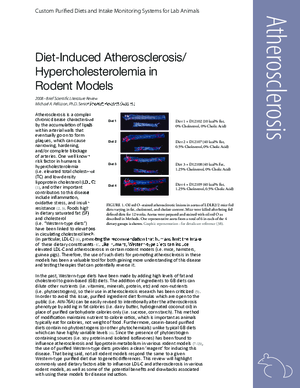
Abstract  

Diet-Induced Atherosclerosis/Hypercholesterolemia in Rodent Models

References

  1. Pearson, T.A., Blair, S.N., Daniels, S.R., Eckel, R.H., Fair, J.M., Fortmann, S.P., Franklin, B.A., Goldstein, L.B., Greenland, P., Grundy, S.M., Hong, Y., Miller, N.H., Lauer, R.M., Ockene, I.S., Sacco, R.L., Sallis, J.F. Jr., Smith, S.C. Jr., Stone, N.J. & Taubert, K.A., 2002. AHA Guidelines for Primary Prevention of Cardiovascular Disease and Stroke: 2002 Update: Consensus Panel Guide to Comprehensive Risk Reduction for Adult Patients Without Coronary or Other Atherosclerotic Vascular Diseases. Circulation, 106, pp.388–391.
  2. Libby, P., Ridker, P.M. & Maseri, A., 2002. Inflammation and atherosclerosis. Circulation, 105, pp.1135–1143.
  3. Van Gaal, L.F., Mertens, I.L. & De Block, C.E., 2006. Mechanisms linking obesity with cardiovascular disease. Nature, 444, pp.875–880.
  4. Hegsted, D.M., McGandy, R.B., Myers, M.L. & Stare, F.J., 1965. Quantitative effects of dietary fat on serum cholesterol in man. The American Journal of Clinical Nutrition, 17, pp.281–295.
  5. Cybulsky, M.I., Lichtman, A.H., Hajra, L. & Iiyama, K., 1999. Leukocyte adhesion molecules in atherogenesis. Clinica Chimica Acta, 286, pp.207–218.
  6. Thigpen, J.E., Setchell, K.D., Ahlmark, K.B., Locklear, J., Spahr, T., Caviness, G.F., Goelz, M.F., Haseman, J.K., Newbold, R.R. & Forsythe, D.B., 1999. Phytoestrogen content of purified, open- and closed-formula laboratory animal diets. Laboratory Animal Science, 49, pp.530–536.
  7. Brown, N.M. & Setchell, K.D., 2001. Animal models impacted by phytoestrogens in commercial chow: implications for pathways influenced by hormones. Laboratory Investigation, 81, pp.735–747.
  8. Mezei, O., Banz, W.J., Steger, R.W., Peluso, M.R., Winters, T.A. & Shay, N., 2003. Soy isoflavones exert antidiabetic and hypolipidemic effects through the PPAR pathways in obese Zucker rats and murine RAW 264.7 cells. The Journal of Nutrition, 133, pp.1238–1243.
  9. Kirk, E., Sutherland, P., Wang, S., Chait, A. & LeBoeuf, R., 1998. Dietary isoflavones reduce plasma cholesterol and atherosclerosis in C57BL/6 mice but not LDL receptor-deficient mice. The Journal of Nutrition, 128, pp.954–959.
  10. Tovar-Palacio, C., Potter, S.M., Hafermann, J.C. & Shay, N.F., 1998. Intake of soy protein and soy protein extracts influences lipid metabolism and hepatic gene expression in gerbils. The Journal of Nutrition, 128, pp.839–842.
  11. Blair, R.M., Appt, S.E., Bennetau-Pelissero, C., Clarkson, T.B., Anthony, M.S., Lamothe, V. & Potter, S.M., 2002. Dietary soy and soy isoflavones have gender-specific effects on plasma lipids in Golden Syrian F1B Hybrid Hamsters. The Journal of Nutrition, 132, pp.3585–3591.
  12. Ascencio, C., Torres, N., Isoard-Acosta, F., Gomez-Perez, F.J., Hernandez-Pando, R. & Tovar, A.R., 2004. Soy protein affects serum insulin and hepatic SREBP-1 mRNA and reduces fatty liver in rats. The Journal of Nutrition, 134, pp.522–529.
  13. Adams, M.R., Golden, D.L., Anthony, M.S., Register, R.C. & Williams, J.K., 2002. The inhibitory effect of soy protein isolate on atherosclerosis in mice does not require the presence of LDL receptors or alteration of plasma lipoproteins. The Journal of Nutrition, 132, pp.43–49.
  14. Nishina, P.M., Wang, J., Toyofuku, W., Kuypers, F.A. & Ishida, B.Y., 1993. Atherosclerosis and plasma and liver lipids in nine inbred strains of mice. Lipids, 28, pp.599–605.
  15. Nishina, P.M., Lowe, S., Verstuyft, J., Naggert, J.K., Kuypers, F.A. & Paigen, B., 1993. Effects of dietary fats from animal and plant sources on diet-induced fatty streak lesions in C57BL/6J mice. Journal of Lipid Research, 34, pp.1413–1422.
  16. Nishina, P.M., Verstuyft, J. & Paigen, B., 1990. Synthetic low and high fat diets for the study of atherosclerosis in the mouse. Journal of Lipid Research, 31, pp.859–869.
  17. Ando, H., Tsuruoka, S., Yamamoto, H., Takamura, T., Kaneko, S. & Fujimura, A., 2005. Regulation of cholesterol 7alpha-hydroxylase mRNA expression in C57BL/6 mice fed an atherogenic diet. Atherosclerosis, 178(2), pp.265–269.
  18. Xu, G., Zhao, L. & Fuchs, M., 2002. Differences between hepatic and biliary lipid metabolism and secretion in genetically gallstone-susceptible and gallstone-resistant mice. Chinese Medical Journal, 115, pp.1292–1295.
  19. Khanuja, B., Cheah, Y.C., Hunt, M., Nishina, P.M., Wang, D.Q., Chen, H.W., Billheimer, J.T., Carey, M.C. & Paigen, B., 1995. Lith1, a major gene affecting cholesterol gallstone formation among inbred strains of mice. Proceedings of the National Academy of Sciences USA, 92(17), pp.7729–7733.
  20. Jeong, W.I., Jeong, D.H., Do, S.H., Kim, Y.K., Park, H.Y., Kwon, O.D., Kim, T.H. & Jeong, K.S., 2005. Mild hepatic fibrosis in cholesterol and sodium cholate diet-fed rats. The Journal of Veterinary Medical Science, 67, pp.235–242.
  21. Yokozawa, T., Cho, E.J., Sasaki, S., Satoh, A., Okamoto, T. & Sei, Y., 2006. The protective role of Chinese prescription kangen-karyu extract on diet-induced hypercholesterolemia in rats. Biological & Pharmaceutical Bulletin, 29(4), pp.760–765.
  22. Zulet, M.A., Barber, A., Garcin, H., Higueret, P. & Martinez, J.A., 1999. Alterations in carbohydrate and lipid metabolism induced by a diet rich in coconut oil and cholesterol in a rat model. Journal of the American College of Nutrition, 18(1), pp.36–42.
  23. Horton, J.D., Cuthbert, J.A. & Spady, D.K., 1995. Regulation of hepatic 7 alpha-hydroxylase expression and response to dietary cholesterol in the rat and hamster. The Journal of Biological Chemistry, 270, pp.5381–5387.
  24. Joris, I., Zand, T., Nunnari, J.J., Krolikowski, F.J. & Majno, G., 1983. Studies on the pathogenesis of atherosclerosis. I. Adhesion and emigration of mononuclear cells in the aorta of hypercholesterolemic rats. The American Journal of Pathology, 113(3), pp.341–358.
  25. Russell, J.C., Graham, S.E. & Richardson, M., 1998. Cardiovascular disease in the JCR:LA-cp rat. Molecular and Cellular Biochemistry, 188(1–2), pp.113–126.
  26. Kahlon, T.S., Chow, F.I., Irving, D.W. & Sayre, R.N., 1996. Cholesterol response and foam cell formation in hamsters fed two levels of saturated fat and various levels of cholesterol. Nutrition Research, 16(8), pp.1353–1368.
  27. Kurushima, H., Hayashi, K., Shingu, T., Kuga, Y., Ohtani, H., Okura, Y., Tanaka, K., Yasunobu, Y., Nomura, K. & Kajiyama, G., 1995. Opposite effects on cholesterol metabolism and their mechanisms induced by dietary oleic acid and palmitic acid in hamsters. Biochimica et Biophysica Acta, 1258(3), pp.251–256.
  28. Dietschy, J.M., 1998. Dietary fatty acids and the regulation of plasma low density lipoprotein cholesterol concentrations. The Journal of Nutrition, 128, pp.444S–448S.
  29. Alexaki, A., Wilson, T.A., Atallah, M.T., Handelman, G. & Nicolosi, R.J., 2004. Hamsters fed diets high in saturated fat have increased cholesterol accumulation and cytokine production in the aortic arch compared with cholesterol-fed hamsters with moderately elevated plasma non-HDL cholesterol concentrations. The Journal of Nutrition, 134, pp.410–415.
  30. Fernandez, M.L. & Volek, J.S., 2006. Guinea pigs: A suitable animal model to study lipoprotein metabolism, atherosclerosis and inflammation. Nutrition & Metabolism, 3, p.17.
  31. Fernandez, M.L., Lin, E.C. & McNamara, D.J., 1992. Differential effects of saturated fatty acids on low density lipoprotein metabolism in the guinea pig. Journal of Lipid Research, 33, pp.1833–1842.
  32. Fernandez, M.L., Wilson, T.A., Conde, K., Vergara-Jimenez, M. & Nicolosi, R.J., 1999. Hamsters and guinea pigs differ in their plasma lipoprotein cholesterol distribution when fed diets varying in animal protein, soluble fiber, or cholesterol content. The Journal of Nutrition, 129, pp.1323–1332.
  33. Fernandez, M.L., Vergara-Jimenez, M., Conde, K. & Abdel-Fattah, G., 1996. Dietary carbohydrate type and fat amount alter VLDL and LDL metabolism in guinea pigs. The Journal of Nutrition, 126, pp.2494–2504.
  34. Lin, E.C., Fernandez, M.L., Tosca, M.A. & McNamara, D.J., 1994. Regulation of hepatic LDL metabolism in the guinea pig by dietary fat and cholesterol. Journal of Lipid Research, 35, pp.446–457.
  35. Cos, E., Ramjiganesh, T., Roy, S., Yoganathan, S., Nicolosi, R.J. & Fernandez, M.L., 2001. Soluble fiber and soybean protein reduce atherosclerotic lesions in guinea pigs. Sex and hormonal status determine lesion extension. Lipids, 36, pp.1209–1216.
  36. Zern, T.L., West, K.L. & Fernandez, M.L., 2003. Grape polyphenols decrease plasma triglycerides and cholesterol accumulation in the aorta of ovariectomized guinea pigs. The Journal of Nutrition, 133, pp.2268–2272.
  37. Torres-Gonzalez, M., Volek, J.S., Sharman, M., Contois, J.H. & Fernandez, M.L., 2006. Dietary carbohydrate and cholesterol influence the number of particles and distributions of lipoprotein subfractions in guinea pigs. The Journal of Nutritional Biochemistry, 17(11), pp.773–779.
  38. Lichtman, A.H., Clinton, S.K., Iiyama, K., Connelly, P.W., Libby, P. & Cybulsky, M.I., 1999. Hyperlipidemia and atherosclerotic lesion development in LDL receptor-deficient mice fed defined semipurified diets with and without cholate. Arteriosclerosis, Thrombosis, and Vascular Biology, 19, pp.1938–1944.
  39. Collins, A.R., Meehan, W.P., Kintscher, U., Jackson, S., Wakino, S., Noh, G., Palinski, W., Hsueh, W.A. & Law, R.E., 2001. Troglitazone inhibits formation of early atherosclerotic lesions in diabetic and nondiabetic low density lipoprotein receptor-deficient mice. Arteriosclerosis, Thrombosis, and Vascular Biology, 21, pp.365–371.
  40. Joseph, S.B., McKilligin, E., Pei, L., Watson, M.A., Collins, A.R., Laffitte, B.A., Chen, M., Noh, G., Goodman, J., Hagger, G.N., Tran, J., Tippin, T.K., Wang, X., Lusis, A.J., Hsueh, W.A., Law, R.E., Collins, J.L., Willson, T.M. & Tontonoz, P., 2002. Synthetic LXR ligand inhibits the development of atherosclerosis in mice. Proceedings of the National Academy of Sciences USA, 99, pp.7604–7609.
  41. Nakashima, Y., Plump, A.S., Raines, E.W., Breslow, J.L. & Ross, R., 1994. ApoE-deficient mice develop lesions of all phases of atherosclerosis throughout the arterial tree. Arteriosclerosis and Thrombosis, 14, pp.133–140.
  42. Merat, S., Casanada, F., Sutphin, M., Palinski, W. & Reaven, P.D., 1999. Western-type diets induce insulin resistance and hyperinsulinemia in LDL receptor-deficient mice but do not increase aortic atherosclerosis compared with normoinsulinemic mice in which similar plasma cholesterol levels are achieved by a fructose-rich diet. Arteriosclerosis, Thrombosis, and Vascular Biology, 19, pp.1223–1230.
  43. Wu, L., Vikramadithyan, R., Yu, S., Pau, C., Hu, Y., Goldberg, I. & Dansky, H.M., 2006. Addition of dietary fat to cholesterol in the diets of LDL receptor knockout mice: effects on plasma insulin, lipoproteins, and atherosclerosis. Journal of Lipid Research, 47, pp.2215–2222.
  44. Davis, H.R., Compton, D.S., Hoos, L. & Tetzloff, G., 2001. Ezetimibe, an important cholesterol absorption inhibitor, inhibits the development of atherosclerosis in apoE knockout mice. Arteriosclerosis, Thrombosis, and Vascular Biology, 21, pp.2032–2038.
  45. Teupser, D., Persky, A.D. & Breslow, J.L., 2003. Induction of atherosclerosis by low-fat, semisynthetic diets in LDL receptor-deficient C57BL/6J and FVB/NJ mice: comparison of lesions of the aortic root, brachiocephalic artery, and whole aorta (en face measurement). Arteriosclerosis, Thrombosis, and Vascular Biology, 23, pp.1907–1913.
  46. Subramanian, S., Han, C.Y., Chiba, T., McMillen, T.S., Wang, S.A., Haw, A., Kirk, E.A., O’Brien, K.D. & Chait, A., 2008. Dietary cholesterol worsens adipose tissue macrophage accumulation and atherosclerosis in obese LDL receptor-deficient mice. Arteriosclerosis, Thrombosis, and Vascular Biology, 28(4), pp.685–691.
  47. Merkel, M., Velez-Carrasco, W., Hudgins, L.C. & Breslow, J.L., 2001. Compared with saturated fatty acids, dietary monounsaturated fatty acids and carbohydrates increase atherosclerosis and VLDL cholesterol levels in LDL receptor-deficient, but not apolipoprotein E-deficient, mice. Proceedings of the National Academy of Sciences USA, 98, pp.13294–13299.