
Abstract  

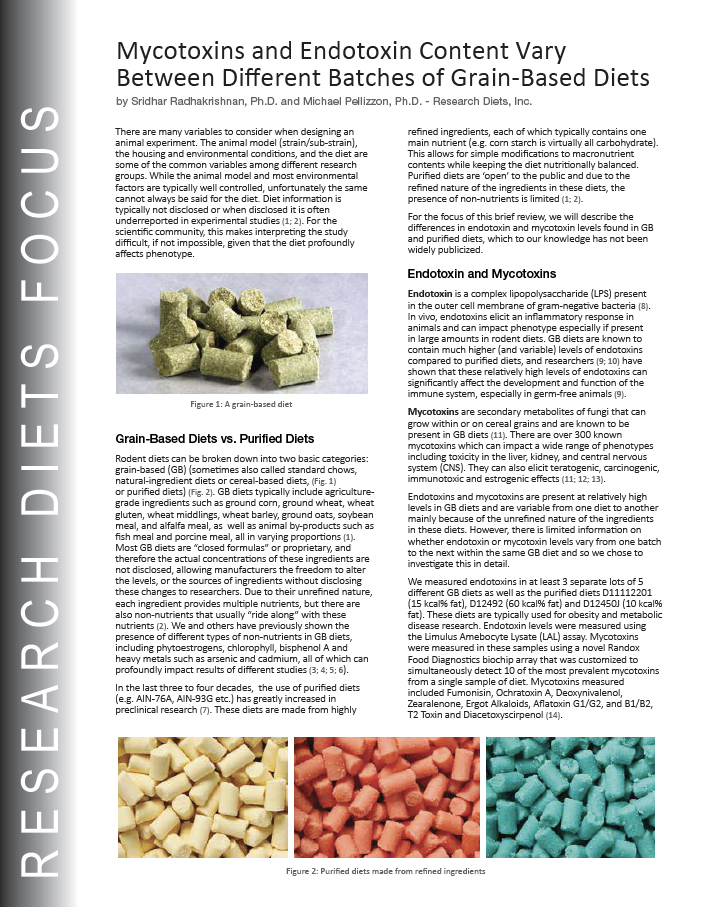
There are many variables to consider when designing an animal experiment. The animal model (strain/sub-strain), the housing and environmental conditions, and the diet are some of the common variables among different research groups. While the animal model and most environmental factors are typically well controlled, unfortunately the same cannot always be said for the diet. Diet information is typically not disclosed or when disclosed it is often underreported in experimental studies (1; 2). For the scientific community, this makes interpreting the study difficult, if not impossible, given that the diet profoundly affects phenotype.
References

  1. Pellizzon MA, Ricci MR. (2018) The common use of improper control diets in diet-induced metabolic disease research confounds data interpretation: the fiber factor. Nutr Metab (Lond). 15:3.
  2. Pellizzon MA, Ricci MR. (2018) Effects of rodent diet choice and fiber type on data interpretation of gut microbiome and metabolic disease research. Curr Protoc Toxicol. e55.
  3. Kozul CD, Nomikos AP, Hampton TH, et al. (2008) Laboratory diet profoundly alters gene expression and confounds genomic analysis in mouse liver and lung. Chem Biol Interact. 173:129–140.
  4. Mesnage R, Defarge N, Rocque LM, et al. (2015) Laboratory rodent diets contain toxic levels of environmental contaminants: implications for regulatory tests. PLoS ONE. 10:e0128429.
  5. Pellizzon MA, Putt DA, Salvati N, et al. (2017) An investigation of bisphenol A (BPA) levels in laboratory rodent diets. Society for Toxicology Annual Meeting. 2853.
  6. Thigpen JE, Setchell KD, Kissling GE, et al. (2013) The estrogenic content of rodent diets, bedding, cages, and water bottles and its effect on bisphenol A studies. J Am Assoc Lab Anim Sci. 52:130–141.
  7. Reeves PG. (1997) Components of the AIN-93 diets as improvements in the AIN-76A diet. J Nutr. 127:838S–841S.
  8. Raetz CR, Whitfield C. (2002) Lipopolysaccharide endotoxins. Annu Rev Biochem. 71:635–700.
  9. Hrncir T, Stepankova R, Kozakova H, et al. (2008) Gut microbiota and lipopolysaccharide content of the diet influence development of regulatory T cells: studies in germ-free mice. BMC Immunol. 9:65.
  10. Schwarzer M, Srutkova D, Hermanova P, et al. (2017) Diet matters: endotoxin in the diet impacts the level of allergic sensitization in germ-free mice. PLoS ONE. 12:e0167786.
  11. Waldemarson AH, Hedenqvist P, Salomonsson AC, et al. (2005) Mycotoxins in laboratory rodent feed. Lab Anim. 39:230–235.
  12. Iheshiulor OOM, Esonu BO, Chuwuka OK, et al. (2011) Effects of mycotoxins in animal nutrition: a review. Asian Journal of Animal Sciences. 5:19–33.
  13. Sun LH, Lei MY, Zhang NY, et al. (2014) Hepatotoxic effects of mycotoxin combinations in mice. Food Chem Toxicol. 74:289–293.
  14. Radhakrishnan S, Pellizzon M, Greiss P, et al. (2019) Mycotoxins and endotoxin content vary between different batches of grain-based chow diets. Society for Toxicology Annual Meeting. 2676.
  15. Pellizzon M. (2016) Choice of laboratory animal diet influences intestinal health. Lab Anim (NY). 45:238–239.