
Abstract
Background: Purified diets (PDs) contain refined ingredients with one main nutrient, allowing for greater control relative to grain-based diets (GBDs), which contain unrefined grains and animal byproducts. Traditional PDs like the American Institute of Nutrition (AIN)-76A (76A) and AIN-93G (93G) can negatively impact metabolic and gut health when fed long term, in part due to lower total fiber, no soluble fiber, and higher sucrose content.
Objective: Two studies were conducted to determine how PDs with reduced sucrose and increased fiber (soluble and insoluble) influence metabolic and gut health in mice compared with traditional AIN PDs or GBDs.
Methods: In study 1, C57Bl/6N mice (n = 75) consumed a GBD [LabDiet 5002 (5002)], 76A, 93G, or 2 PDs with reduced sucrose and higher fiber for 88 d. Body composition and metabolic parameters were assessed. In study 2, C57Bl/6N mice (n = 54) consumed either 2 GBDs (LabDiet 5001 or 5002) or PDs with different types/levels of fiber for 14 d. Microbiome alterations and predicted functional metagenomic changes were measured.
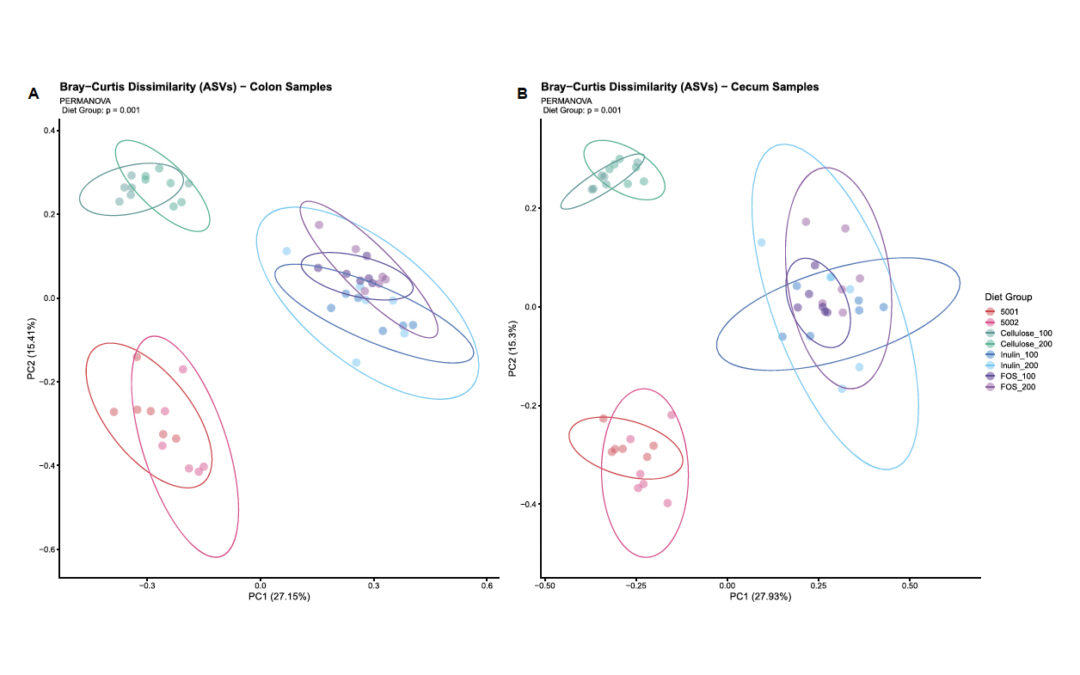
Results: The PD with 75 g cellulose and 25 g inulin per 4084 kcals marginally influenced body weight and adiposity, but improved glucose tolerance relative to 93G (P= 0.0131) and 76A (P= 0.0014). Cecal and colonic weights were lower in mice fed cellulose-based PDs compared with those fed GBDs and soluble-fiber PDs. Soluble-fiber PDs reduced alpha diversity and showed similar beta diversity, which differed from cellulose-based PDs and GBDs. Certain genera associated with improved gut health such as Bifidobacteria and Akkermansia were significantly elevated by soluble-fiber PDs (P ≤ 0.01). Metabolic pathways related to carbohydrate and fatty acid metabolism were affected by PDs.
Conclusions: PDs formulated with lower sucrose and increased fiber content, particularly soluble fiber, blunted elevations in metabolic parameters and favorably impacted the microbiota and metagenome in C57BL/6N mice. Curr Dev Nutr 2022;6:nzac105.
References
- Pellizzon MA, Ricci MR. Choice of laboratory rodent diet may confound data interpretation and reproducibility. Curr Dev Nutr 2020;4(4): nzaa031.
- Wise A. Interaction of diet and toxicity—the future role of purified diet in toxicological research. Arch Toxicol 1982;50:287–99.
- Pellizzon M, Radhakrishnan S, Ricci M. Mycotoxins and endotoxin content vary between different batches of grain-based chow diets. Abstract # 2676. Baltimore(MD): The Toxicologist;2019.
- Pellizzon MA, Ricci MR. Effects of rodent diet choice and fiber type on data interpretation of gut microbiome and metabolic disease research. Curr Protocol Toxicol 2018;77(1): e55.
- Reeves PG, Nielsen FH, Fahey GC. AIN-93 purified diets for laboratory rodents: final report of the American Institute of Nutrition ad hoc writing committee on the reformulation of the AIN-76A rodent diet. J Nutr 1993;123(11):1939–51.
- Bieri J, Stoewsand G, Briggs G, Phillips R, Woodard J, Knapka J. Report of the American Institute of Nutrition ad hoc committee on standards for nutritional studies. J Nutr 1977;107:1340–8.
- Syed R, Shibata NM, Kharbanda KK, Su RJ, Olson K, Yokoyama A, et al. Effects of nonpurified and choline-supplemented or nonsupplemented purified diets on hepatic steatosis and methionine metabolism in C3H mice. Metab Syndr Relat Disord 2016;14(4):202–9.
- Klurfeld DM, Gregory JF, III, Fiorotto ML. Should the AIN-93 rodent diet formulas be revised? J Nutr 2021;151(6):1380–2.
- González-Blázquez R, Alcalá M, Fernández-Alfonso MS, Villa-Valverde P, Viana M, Gil-Ortega M, et al. Relevance of control diet choice in metabolic studies: impact in glucose homeostasis and vascular function. Sci Rep 2020;10(1):2902.
- WiseA, GilburtDJ.The variability of dietary fibre in laboratory animal diets and its relevance to the control of experimental conditions. Food Cosmet Toxicol 1980;18(6):643–8.
- Sleder J, Chen YD, Cully MD, Reaven GM. Hyperinsulinemia in fructose-induced hypertriglyceridemia in the rat. Metabolism 1980;29(4): 303–5.
- Thresher JS, Podolin DA, Wei Y, Mazzeo RS, Pagliassotti MJ. Comparison of the effects of sucrose and fructose on insulin action and glucose tolerance. Am J Physiol Regul Integr Comp Physiol 2000;279(4):R1334–40.
- Pagliassotti MJ, Prach PA. Quantity of sucrose alters the tissue pattern and time course of insulin resistance in young rats. Am J Physiol Regul Integr Comp Physiol 1995;269(3):R641–6.
- Flamm G, Glinsmann W, Kritchevsky D, Prosky L, Roberfroid M. Inulin and oligofructose as dietary fibre: a review of the evidence. Crit Rev Food Sci Nutr 2001;41(5):353–62.
- Levrat MA, Rémésy C, Demigné C. High propionic acid fermentations and mineral accumulation in the cecum of rats adapted to different levels of inulin. J Nutr 1991;121(11):1730–7.
- Campbell JM, FaheyGC, Jr, Wolf BW. Selected indigestible oligosaccharides affect large bowel mass, cecal and fecal short-chain fatty acids, pH and microflora in rats. J Nutr 1997;127(1):130–6.
- ChassaingB, Miles-BrownJ, PellizzonM, UlmanE, RicciM, ZhangL, et al. Lack of soluble fiber drives diet-induced adiposity in mice. Am J Physiol Gastrointest Liver Physiol 2015;309(7):G528–41.
- Zou J, Chassaing B, Singh V, Pellizzon M, Ricci M, Fythe MD, et al. Fibre-mediated nourishment of gut microbiota protects against diet-induced obesity by restoring IL-22-mediated colonic health. Cell Host Microbe 2018;23(1):41–53.e4.
- Brooks L, Viardot A, Tsakmaki A, Stolarczyk E, Howard JK, Cani PD, et al. Fermentable carbohydrate stimulates FFAR2-dependent colonic PYY cell expansion to increase satiety. Mol Metab 2017;6(1):48–60.
- Pérez-Monter C, Álvarez-Arce A, Nuño-Lambarri N, Escalona-Nández I, Juárez-Hernández E, Chávez-Tapia NC, et al. Inulin improves diet-induced hepatic steatosis and increases intestinal Akkermansia genus level. Int J Mol Sci 2022;23(2):991.
- Roberfroid MB. Introducing inulin-type fructans. Br J Nutr 2005;93(Suppl 1):S13–25.
- Prosky L, Asp NG, Schweizer T, Devries J. Determination of insoluble and soluble dietary fibre in foods and food products. J Assoc Off Anal Chem 1992;68(4):677–9.
- LeeSC, ProskyL, DeVriesJW. Determination of total, soluble, and insoluble dietary fiber in foods - enzymatic-gravimetric method, MES-TRIS buffer: collaborative study. J AOAC Int 1992;75(3):395–416.
- Bligh EG, Dyer WJ. A rapid method of total lipid extraction and purification. Can J Biochem Physiol 1959;37(8):911–17.
- Bieri JG.Second report of the ad hoc Committee on Standards for Nutritional Studies. J Nutr 1980;110(8):1726.
- O’Brien P, Han G, Ganpathy P, Pitre S, Zhang Y, Ryan J, et al. Chronic effects of a high sucrose diet on murine gastrointestinal nutrient sensor gene and protein expression levels and lipid metabolism. Int J Mol Sci 2021;22(1):137.
- Sumiyoshi M, Sakanaka M, Kimura Y. Chronic intake of high-fat and high-sucrose diets differentially affects glucose intolerance in mice. J Nutr 2006;136(3):582–7.
- Reeves PG. Components of the AIN-93 diets as improvements in the AIN-76 Adiet. J Nutr 1997;127(5):838S–41S.
- Baena M, Sangüesa G, Dávalos A, Latasa M-J, Sala-Vila A, Sánchez RM, et al. Fructose, but not glucose, impairs insulin signaling in the three major insulin-sensitive tissues. Sci Rep 2016;6(1):26149.
- Singh RK, Chang H-W, Yan D, Lee KM, Ucmak D, Wong K, et al. Influence of diet on the gut microbiome and implications for human health. J Transl Med 2017;15(1):73.
- So D, Whelan K, Rossi M, Morrison M, Holtmann G, Kelly JT, et al. Dietary fiber intervention on gut microbiota composition in healthy adults: a systematic review and meta-analysis. Am J Clin Nutr 2018;107(6):965–83.
- Fischer F, Romero R, Hellhund A, Linne U, Bertrams W, Pinkenburg O, et al. Dietary cellulose induces anti-inflammatory immunity and transcriptional programs via maturation of the intestinal microbiota. Gut Microbes 2020;12(1):1829962.
- Pontifex MG, Mushtaq A, Le Gall G, Rodriguez-Ramiro I, Blokker BA, Hoogteijling MEM, et al. Differential influence of soluble dietary fibres on intestinal and hepatic carbohydrate response. Nutrients 2021;13(12):4278.
- Griffin LE, Witrick KA, Klotz C, Dorenkott MR, Goodrich KM, Fundaro G, et al. Alterations to metabolically active bacteria in the mucosa of the small intestine predict anti-obesity and anti-diabetic activities of grapeseed extract in mice. Food Funct 2017;8(10):3510–22.
- Rabot S, Membrez M, Blancher F, Berger B, Moine D, Krause L, et al. High-fat diet drives obesity regardless of the composition of gut microbiota in mice. Sci Rep 2016;6(1):32484.
- Hwang I, Park YJ, Kim Y-R, Kim YN, Ka S, Lee HY, et al. Alteration of Gut microbiota by vancomycin and bacitracin improves insulin resistance via glucagon-like peptide 1 in diet-induced obesity. FASEB J 2015;29(6):2397–411.
- Parnell JA, Reimer RA. Prebiotic fibres dose-dependently increase satiety hormones and alter Bacteroidetes and Firmicutes in lean and obese JCR: LA-cprats. Br J Nutr 2012;107(4):601–13.
- Zhou K. Strategies to promote abundance of Akkermansia muciniphila, an emerging probiotic in the gut, evidence from dietary intervention studies. J Funct Foods 2017;33:194–201.
- Cani PD, Osto M, Geurts L, Everard A. Involvement of gut microbiota in the development of low-grade inflammation and type 2 diabetes associated with obesity. Gut Microbes 2012;3(4):279–88.
- Reid DT, Eller LK, Nettleton JE, Reimer RA. Postnatal prebiotic fibre intake mitigates some detrimental metabolic outcomes of early overnutrition in rats. Eur J Nutr 2016;55(8):2399–409.
- Everard A, Lazarevic V, Gaïa N, Johansson M, Stahlman M, Backhed F, et al. Microbiome of prebiotic-treated mice reveals novel targets involved in host responded to obesity.ISMEJ2014;8(10):2116–30.
- Lee J-H, O’Sullivan DJ. Genomic insights into Bifidobacteria. Microbiol Mol Biol Rev 2010;74(3):378–416.
- Cani PD, Amar J, Iglesias MA, Poggi M, Knauf C, Bastelica D, et al. Metabolic endotoxemia initiates obesity and insulin resistance. Diabetes 2007;56(7):1761–72.
- Ley RE, Turnbaugh PJ, Klein S, Gordon JI. Microbial ecology: human gut microbes associated with obesity. Nature 2006;444(7122):1022–3.
- Vacca M, Celano G, Calabrese FM, Portincasa P, Gobbetti M, De Angelis M. The controversial role of human gut Lachnospiraceae. Microorganisms 2020;8(4):573.
- Tamanai-Shacoori Z, Smida I, Bousarghin L, Loreal O, Meuric V, Fong SB, et al. Roseburia spp.: a marker of health? Future Microbiol 2017;12(2):157–70.
- Douglas GM, Beiko RG, Langille MGI. Predicting the functional potential of the microbiome from marker genes using PICRUSt. Methods Mol Biol 2018;1849:169–77.
- Brown K, Abbott DW, Uwiera RRE, Inglis GD. Removal of the cecum affects intestinal fermentation, enteric bacterial community structure, and acute colitis in mice. Gut Microbes 2018;9(3):218–35.
- Kim Y, Hwang SW, Kim S, Lee Y-S, Kim T-Y, Lee S-H, et al. Dietary cellulose prevents gut inflammation by modulating lipid metabolism and the gut microbiota. Gut Microbes 2020;11(4):944–61.
- Dalby MJ, Ross AW, Walker AW, Morgan PJ. Dietary uncoupling of gut microbiota and energy harvesting from obesity and glucose tolerance in mice. Cell Rep 2017;21(6):1521–33.
- Daniel N, Rossi Perazza L, Varin TV, Trottier J, Marcotte B, St-Pierre P, et al. Dietary fat and low fibre in purified diets differently impact the gut-liver axis to promote obesity-linked metabolic impairments. Am J Physiol Gastrointest Liver Physiol 2021;320(6):G1014–33.